


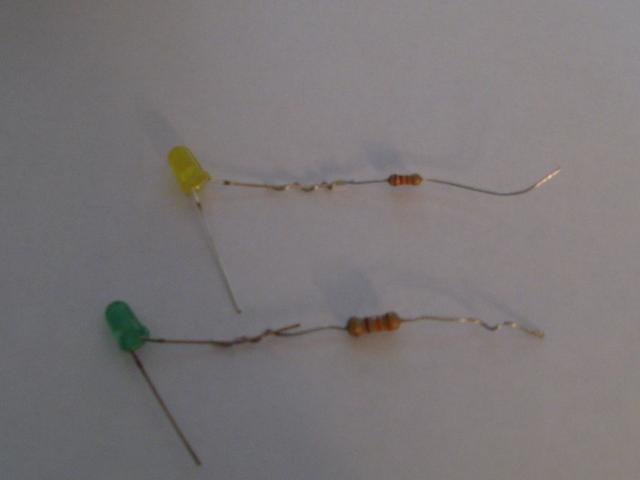
The first picture below shows a typical LED with a resistor attached to the Anode (The longer lead) of an LED.. The other end would go to the negative batter source.. Think of the LED ( or any other Diode) as a gateway that only allows current flow in one direction..(See the picture on the right of the second image) If you put anode to positve and cathode to negative, the gateway opens ... put in the other direction, the gateway is closed.. Also, remember the forward voltag drop? Well, if the gateway is postioned to be opened, it will only open if the voltge exceeds the forward voltage drop.. LED's 3.4v as an example.. For Diodes (.7 volts) ..so you can see how they would act like a switch..
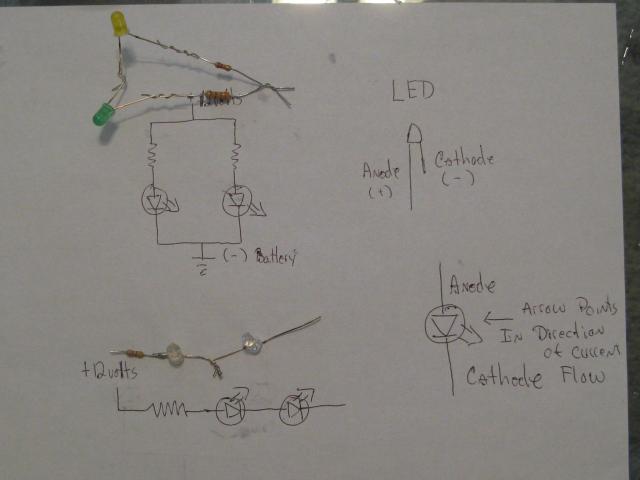
The second image -- Top pic is an example of two LED"s wired in parallel.. ( Standard way of wiring).. As you can see, each anode is connected to a resistor that then connects to +12 volts.. The other end of the LED, the Anode, is connected to ground.. As you can also see, the Arrow point in the direction that the current is supposed to flow.. (Trivia: The arrows are actually pointing in the wrong direction because current actually flows from negative to positive, NOT postive to negative)
So, wiring in Paralell is like having several different circuits connected to the same power supply....
The second picture shows 2 LED's wired in series. Not the most ideal way of wiring them... Here we have a single resistor connected to the power supply to the Anode of the first LED.. The cathode of the first LED then connects to the anode of the second LED and the cathode of the second LED then goes to the negative supply of the power supply.. It bascially two gateways one right after the other..
What happens if I postion the arrow of the 2nd LED so the arrow points in the other direction (cathode connected to positive)?
Answer:
The entire circuit will not work because the gateway will be closed.. so that curent cannot flow to ground.. In that same respect, if one or the LED fries.. the entire cicuit will not work.
The second image -- Top pic is an example of two LED"s wired in parallel.. ( Standard way of wiring).. As you can see, each anode is connected to a resistor that then connects to +12 volts.. The other end of the LED, the Anode, is connected to ground.. As you can also see, the Arrow point in the direction that the current is supposed to flow.. (Trivia: The arrows are actually pointing in the wrong direction because current actually flows from negative to positive, NOT postive to negative)
So, wiring in Paralell is like having several different circuits connected to the same power supply....
The second picture shows 2 LED's wired in series. Not the most ideal way of wiring them... Here we have a single resistor connected to the power supply to the Anode of the first LED.. The cathode of the first LED then connects to the anode of the second LED and the cathode of the second LED then goes to the negative supply of the power supply.. It bascially two gateways one right after the other..
What happens if I postion the arrow of the 2nd LED so the arrow points in the other direction (cathode connected to positive)?
Answer:
The entire circuit will not work because the gateway will be closed.. so that curent cannot flow to ground.. In that same respect, if one or the LED fries.. the entire cicuit will not work.
see my other builds at:
http://www.skunkwurkzmodels.com
http://www.skunkwurkzmodels.com