I am currently working on a model of the Narcissus from Alien and thought I might share some of my work.
I have spent the past few years collecting reference images and information and I now think I am at the point where I can make a start!
The initilal issue with trying to build this particular model is that of reference.
The ship went over to the US for display with a number of other models and props to promote the movie, and unfortunately was never seen again.
This means there is zero possiblity of getting any photos or reference that isn't at least 30 odd years old. Thankfully, the guys in the model shop were pretty keen to document thier work and there are dozens of WIP photos "out there".
I have been scouring the net for the past few years and have what I believe is all the reference that is publically available (and not in private collections).
For this build, I want to make it as accurate to the original as can be. After seeing a number of projects over on the RPF utilising photogrammetry, I was keen to see if I could use the technology for this build. Unfortunately, it turns out that it is not possible... With the model no longer around and the existing photos not of a high enough quality and quantity to be usable and the fact that they are film based images which have probably been scanned/cropped/modified, means that it is just not a viable option.
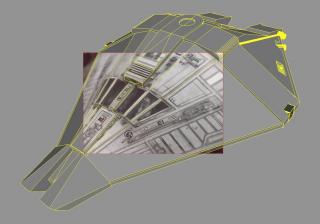
I took another approach... I built a 3D model, and used the known kit parts as reference for the initial scaling. Once this was done, I then imported the model into sketchup and attempted to match the exact angle and focal length of the photos to the model (using it's rather niffty "photomatch" utility). Having done this, it is then a matter of tweaking the model a mm at a time and re-matching it to the photos. Now that all sounds simple, but I have "tweaked" close to 200 versions of the model now over a period of months, BUT I do have it matched very closely to no less than 24 separate reference images. As it current sits, this is only for the main "body" of the ship, but its amazing how much I am able to pick up regarding its geometry and how it was constructed. You can see areas of the model which should be symetrical, but clearly were not (see the nose on the last photo as an example) - not surprising considering this is a hand fabricated model made 30 years ago!. BUT, this technique will allow me to match even these "oddities" exactly.
Now that the main body is complete/matched, it is now a fairly simple (if time consuming) exersize of adding all the styrene/plasticard and kit parts to the model and adjusting the sizing and positions to align with the photos.
When it's done, I don't believe it would be possible to get it any more accurate without actually having access to the original model.
Some screen shots of the 3D model (in yellow) photo matched and overlayed on the reference photos to illustrate:



I have spent the past few years collecting reference images and information and I now think I am at the point where I can make a start!
The initilal issue with trying to build this particular model is that of reference.
The ship went over to the US for display with a number of other models and props to promote the movie, and unfortunately was never seen again.
This means there is zero possiblity of getting any photos or reference that isn't at least 30 odd years old. Thankfully, the guys in the model shop were pretty keen to document thier work and there are dozens of WIP photos "out there".
I have been scouring the net for the past few years and have what I believe is all the reference that is publically available (and not in private collections).
For this build, I want to make it as accurate to the original as can be. After seeing a number of projects over on the RPF utilising photogrammetry, I was keen to see if I could use the technology for this build. Unfortunately, it turns out that it is not possible... With the model no longer around and the existing photos not of a high enough quality and quantity to be usable and the fact that they are film based images which have probably been scanned/cropped/modified, means that it is just not a viable option.
I took another approach... I built a 3D model, and used the known kit parts as reference for the initial scaling. Once this was done, I then imported the model into sketchup and attempted to match the exact angle and focal length of the photos to the model (using it's rather niffty "photomatch" utility). Having done this, it is then a matter of tweaking the model a mm at a time and re-matching it to the photos. Now that all sounds simple, but I have "tweaked" close to 200 versions of the model now over a period of months, BUT I do have it matched very closely to no less than 24 separate reference images. As it current sits, this is only for the main "body" of the ship, but its amazing how much I am able to pick up regarding its geometry and how it was constructed. You can see areas of the model which should be symetrical, but clearly were not (see the nose on the last photo as an example) - not surprising considering this is a hand fabricated model made 30 years ago!. BUT, this technique will allow me to match even these "oddities" exactly.
Now that the main body is complete/matched, it is now a fairly simple (if time consuming) exersize of adding all the styrene/plasticard and kit parts to the model and adjusting the sizing and positions to align with the photos.
When it's done, I don't believe it would be possible to get it any more accurate without actually having access to the original model.
Some screen shots of the 3D model (in yellow) photo matched and overlayed on the reference photos to illustrate:


![[Image: smile.png]](https://www.therpf.com/images/styles/smilies/smile.png)

![[Image: surprised.png]](https://www.therpf.com/images/styles/smilies/surprised.png) ).
).![[Image: sad.png]](https://www.therpf.com/images/styles/smilies/sad.png)